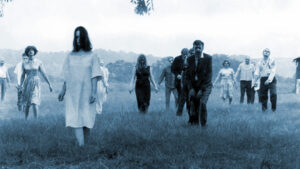
In George Romero’s The Amusement Park, an old man steps from a white room, his suit carefully pressed, his face bright with expectation. The day ahead seems harmless. Within minutes, he is jostled, cheated, and ignored as he wanders through a fairground that promises delight and delivers indifference. “There’s nothing outside,” warns his battered double before the journey begins. The warning belongs as much to us as to him.
The horror in Romero’s vision lies in recognition. The film reflects a civilization that has drifted away from time itself. We have forgotten how to inhabit age or live beside it. Beneath that loss runs something deeper than policy or economics: a wound in the old balance between youth and memory. What many describe as ageism reveals a metaphysical amnesia.
Carl Jung once observed that a culture inevitably projects what it represses. A society that hides from mortality must cast its fear upon visible bodies. The elderly become screens for the dread of decline. The impatience that meets them, the jokes at their expense, express a psychic refusal to acknowledge limits. In The Amusement Park, the young recoil from the old man not because of what he does, but because of what he embodies: the slow erosion of control. When a mother spits the word “degenerate,” she expresses no moral judgment, only the wish to distance herself from her own future.
Jung named two complementary archetypes: the puer aeternus, the eternal youth of vitality and beginnings, and the Senex, the elder figure of structure and continuity. Civilizations need both to remain whole. When youth becomes the sole ideal, the Senex disappears. What takes his place is a culture of restlessness, full of activity but without direction. Ours celebrates the cult of the new: the language of innovation, the pursuit of speed, the worship of constant change. The elder returns only as redundancy, the slow employee to replace, the retiree to manage, the human presence that disrupts the rhythm of efficiency. In Romero’s fairground, the old ride wooden horses labeled “Public Transportation.” The image captures motion that circles endlessly, progress emptied of meaning.
Modern life sustains itself on a polished mask: the ageless, efficient persona. Anything that cannot sustain that image—fragility, dependency, care—is pushed aside. The presence of the old makes the mask tremble, so they are hidden from sight, replaced by advertisements for endless wellness. In one scene, Romero’s protagonist, weak and burdened by grocery bags, pleads for help. Strangers look away. His helplessness threatens their illusion that self-sufficiency can last forever. Every persona, given time, disintegrates.
The fate of the elder echoes the fate of the feminine. Both stand for rhythm, return, and interdependence—qualities the modern mind treats as weakness. To age is to enter cyclical time, to live in the seasons of repair and recollection. The dominant culture values only the straight line: the sprint, the next goal, the unbroken ascent. In such a world, care becomes a task rather than a relation. In the film’s dining scene, the old are fed white bread and chili while the wealthy eat lobster. The contrast shows the emptiness of care without presence, nourishment stripped of intimacy.
Jung described individuation as the slow unfolding of the whole self. Youth reaches outward to build and acquire; later life turns inward to reconcile and give form. When a society neglects that second stage, development itself halts. The middle-aged entrepreneur chasing his next venture stands beside Romero’s old man in the same stalled procession. Both move without direction. The refusal to grow old becomes a refusal to grow.
The elder embodies memory, the connective tissue of culture. When the old are excluded, continuity dissolves. What remains is spectacle, a mirror of surfaces that reflects only itself. Baudrillard called it hyperreality, a play of images without depth. Romero’s white room, sterile and circular, captures that state perfectly. Experience returns to its beginning, without memory or progress.
Neglecting the elderly appears a social failure, but it is also a spiritual one. A world that measures worth by productivity cannot tolerate dependency. Efficiency leaves no room for slowness, reflection, or ritual. What does not multiply profit is renamed waste. The result is fatigue disguised as ambition, irony in place of reverence. The amusement park becomes the emblem of our restlessness—bright, noisy, and hollow.
Restoration begins in imagination before it reaches policy. Wisdom belongs not to an age but to a way of dwelling in time. To recover the Senex means creating space for counsel, for speech that carries memory rather than advertisement. It means valuing endurance above acceleration, reweaving the daily fabric that joins generations through shared labor and care. The purpose is not to glorify age but to restore continuity in a culture that worships beginnings. The elderly are not remnants of a vanished past; they are living archives of the world that continues. Through them we recover a truth once known: that limits dignify experience, that dependence deepens community, that endings confer meaning on beginnings.
At the close of the film, Maazel’s weary voice urges, “While you are still young enough to take positive action, make sure that after your life in the amusement park, you do not end up in a sterile white room.” His words invite rather than warn. To see the elder as future self is to return to life in its full measure. What disturbs us in age reveals what we have refused to accept—time, need, and vulnerability. When we face that image without turning away, we remember that life is not a performance of independence but a shared continuum that joins the living, the dying, and those still to come.